 Malcolm Gauld
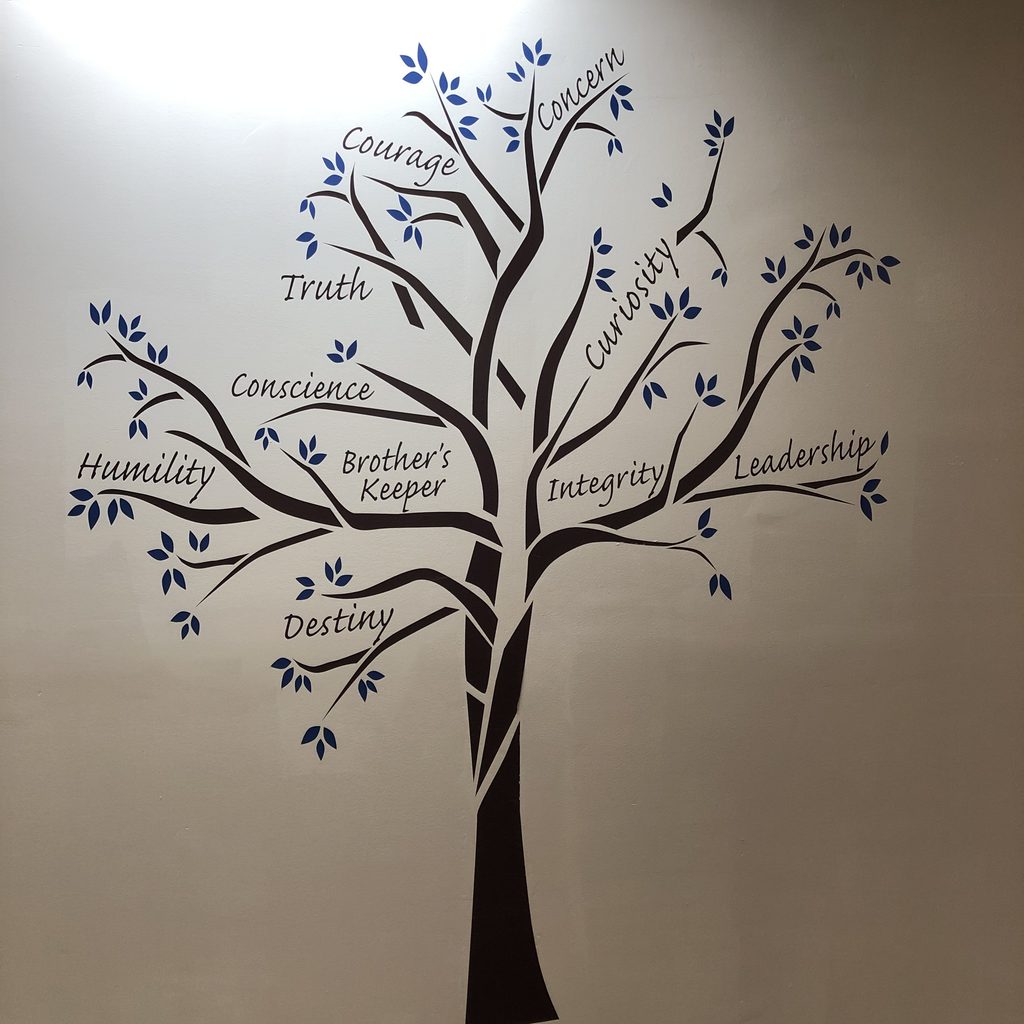
The Hyde philosophy and program rest on two premises. First, if we honor the Five Words, we will develop character. Second, if we honor the Five Principles, we will discover a deeper purpose in our lives.
Working together, the Five Words and Five Principles form the backbone of our respective unique potentials.
They can, however, and sometimes should be considered separately.
My own student days at Hyde occurred a quarter-century before the 5 Principles came upon the scene. As powerful as the 5 Words were and remain in so many of my and my peers’ lives, as the school evolved beyond its teen years, there was a growing sense that something may have been missing. Through the eyes of a student, it may have looked like this: OK, I see how the 5 Words can help me get there, but… How do I determine where it is I want to go?
Not long after it became clear that the 5 Principles were more than a passing fad at Hyde — 1990ish — a young student at a school meeting crystallized a synthesis that has been with us ever since: “Oh, I think I get it: The 5 Words are what I need to do and the 5 Principles are what We need to do.” Nearly 30 years later, I cannot improve much upon that synopsis. So, maybe I’ll take a shot at embellishing it just a bit…
Destiny
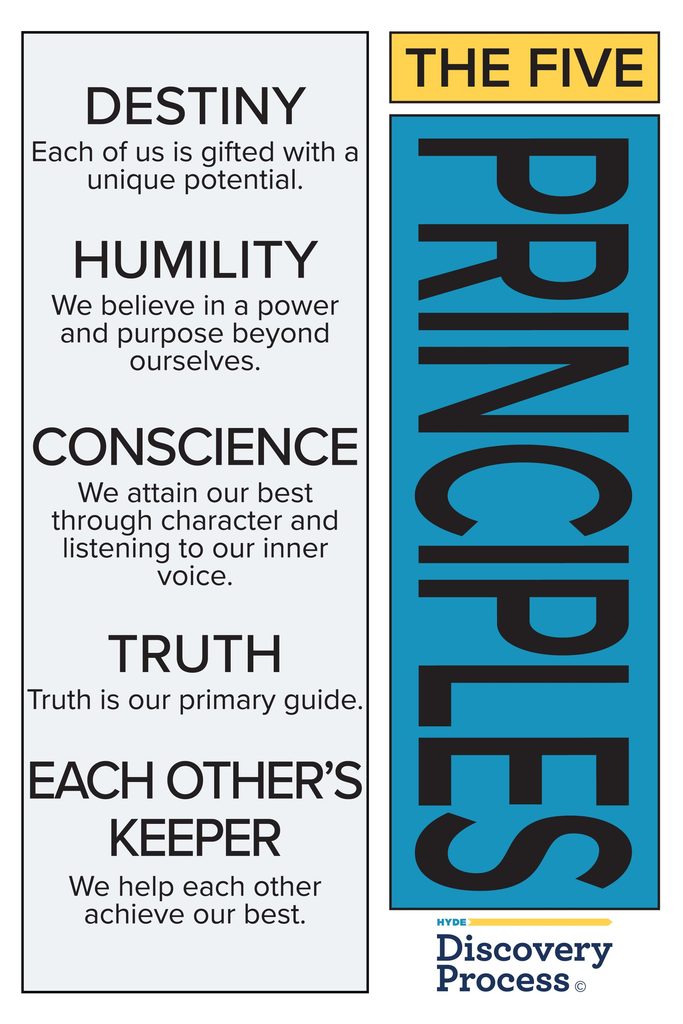
Spend any time at Hyde and it’s hard to miss the fundamental tenet of the school: Every individual is gifted with a unique potential that defines a destiny. Hence, you might do well to consider destiny and unique potential as interchangeable concepts. We believe that strengthening our character and connecting with our conscience can enhance our prospects for an eventual date with this destiny.
Humility
When people first encounter the humility principle at Hyde, some have thought we are pushing religion on them. Nope. When folks bring that up, I sometimes respond, “Here’s a bottom-line statement to ponder: I don’t know what the center of the universe is… I only know it’s not me. If you can’t say that, this school may not be for you.”
I’ve picked up a number of gems along the way that have helped me develop my own understanding of Humility. Here are two:
- Humility is when you help someone else and no one else knows about it.
- Humility does not mean thinking less of yourself. It means thinking of yourself less.
Conscience
Our lifelong struggle to distinguish between our inner voices of ego and conscience pits our self-centered animal instincts against the powerful call of reflecting our best self. We try to help emerging teenagers strike a constructive balance between the urge to pursue primitive wants versus a newer, perhaps unfamiliar voice counseling truth and a higher purpose. The hope is that our students will develop an inner guidance system they will utilize for the rest of their lives.

Truth
Truth alone will not produce genuine character development. (It would also make for a brutal school climate.) However, the other 9 Words and Principles together, without Truth, will never do the job. Furthermore, when a school culture simply does not feel quite right, as though something is amiss, more often than not, that missing ingredient points to Truth.
Of the ten concepts expressed in Hyde’s 5 Words & 5 Principles, three target truth-telling: Integrity, Truth, and Conscience. That’s not an accident. Furthermore, walk the halls, and it will not be long before you hear somebody say something like “The truth is my primary guide” Or “When in doubt bet on the truth… Still in doubt, bet on more truth.” When it comes to my own efforts to maintain Truth as my primary guide, I’m partial to a quote from David Foster Wallace’s 1996 novel Infinite Jest: “The truth will set you free. But not until it is finished with you.”
Each Other’s Keeper
It is one thing for students to be nice to one another; that is important and expected. It is another thing entirely for them to challenge each other to do their best as students, as teammates, as…people. Each Other’s Keeper (EOK) has been characterized as the proper balance “between a bear hug and a kick in the pants.”
One of the best explanations I’ve come across comes from a guy on Substack, someone who may never have heard of Hyde, author/psychologist Adam Grant:
“Bad friends enable bad choices. Good friends help each other make better choices. Loyalty is not about giving people unwavering approval. It’s about being consistent in supporting their growth. True allegiance is holding each other to high standards.”
Yup.
Onward, Malcolm